
The Surprising History of Handel's Messiah
12 Things You Probably Didn't Know About Handel's Messiah
From banned hoop skirts and backstage drama to the surprising origins of a Christmas tradition, the story behind Handel's masterpiece is anything but ordinary.
Every December, audiences gather to experience Handel's Messiah, one of the most recognizable and beloved works in classical music. For Boston Baroque, it's a tradition that stretches back to 1981, when founding Music Director Martin Pearlman led Boston's first complete period-instrument performance of the oratorio.
But long before Messiah became a holiday staple, it had a rather unexpected history.
A premiere so popular that audiences were asked to rethink their wardrobes. A composer who finished the score in just 24 days. A work that nearly failed to find its footing in London.

Think you know Handel's Messiah? Here are 12 facts that might surprise you.
1. The first audience was asked to leave their hoop skirts and swords at home.
True, and for a very practical reason.
When Messiah premiered in Dublin on April 13, 1742, demand for tickets was extraordinary. Organizers reportedly asked women to attend without their fashionable hooped skirts and gentlemen to leave their swords behind.
Why? To squeeze more people into the concert hall.
The audience reportedly numbered around 700 people, packed into a venue normally accommodating roughly 600.
Apparently, Messiah was a hot ticket from day one.
2. Handel wrote the entire thing in just 24 days.
Yes, really.
In August 1741, Handel began composing Messiah at his London home. By September 14, he had completed the monumental score.
That's roughly three weeks to write nearly three hours of music, including some of the most recognizable choruses in classical music.
And his librettist, Charles Jennens, wasn't entirely impressed. Despite the astonishing speed, Jennens complained about aspects of the composition and believed Handel could have done better.
Even masterpieces get notes.
3. Messiah became a Christmas tradition partly because of concert programming.
It wasn't originally a Christmas concert at all.
The first performance took place in April, during the Easter season, and the work encompasses far more than the Nativity. Its three parts explore the birth, suffering, death, and Resurrection of Christ, as well as the promise of redemption.
So how did it become synonymous with Christmas?
During the 19th century, concert presenters increasingly programmed Messiah during the holiday season, when audiences were especially receptive to large choral performances and festive musical traditions.
Over time, repeated December performances helped establish Messiah as a Christmas institution.
In other words, centuries of concert programming helped turn an Easter-season premiere into a holiday tradition.
4. Handel recycled love songs to create some of Messiah's most famous choruses.
A little musical recycling never hurt anyone.
Before composing Messiah, Handel had written a collection of Italian chamber duets about love, romance, and human emotion.
He later repurposed music from several of these duets for Messiah, including portions of "For Unto Us a Child Is Born," "All We Like Sheep," and "His Yoke Is Easy."
Some musical gestures that originally illustrated romantic Italian lyrics found entirely new meaning when paired with biblical texts.
It's a fascinating reminder that even Handel knew when a good musical idea deserved a second life.
Curious what else Handel borrowed? Explore Martin Pearlman's notes on Messiah.
5. Boston Baroque helped change how Boston heard Messiah.
In 1981, Boston Baroque introduced something different.
Under founding Music Director Martin Pearlman, the ensemble presented Boston's first complete period-instrument performances of Handel's Messiah.
At the time, audiences were accustomed to hearing the work with the fuller orchestral textures and more monumental approach inherited from the 19th century.
Boston Baroque offered a different perspective: the distinctive sounds of Baroque instruments, more detailed articulation, lively rhythms, and a renewed sense of theatrical drama.
The performances helped establish what would become one of Boston Baroque's most cherished annual traditions.
More than four decades later, that spirit of musical discovery remains central to every performance.
6. The "Hallelujah" Chorus wasn't originally the grand finale.
Surprise! There's still more music after it.
The famous "Hallelujah" Chorus closes Part II of Messiah, not the entire work.
Part III continues with music reflecting on resurrection and eternal life, including the soprano aria "I Know That My Redeemer Liveth" and the monumental concluding chorus, "Worthy Is the Lamb," followed by the final "Amen."
As thrilling as "Hallelujah" may be, Handel saved some of his most extraordinary writing for the very end.
7. Handel's Messiah was almost too controversial for London.
Dublin loved it. London was a tougher crowd.
Following its successful Irish premiere, Handel brought Messiah to London in 1743, where the reception was considerably cooler.
Some critics objected to biblical texts being performed in a theater rather than a church. Others questioned whether performers associated with the opera stage should be presenting sacred material.
Handel even avoided prominently advertising the work under its now-famous title, presenting it instead as a sacred oratorio.
It took years, and a series of charitable performances, for London audiences to fully embrace the work.
8. The tradition of standing for "Hallelujah" might be based on a myth.
You've probably heard the story.
According to legend, King George II was so moved by the "Hallelujah" Chorus that he stood during a performance, prompting everyone else to rise out of respect.
There's just one problem: historians haven't found reliable contemporary evidence that it happened.
The story emerged decades after the supposed event, leaving its origins uncertain.
Today, some audiences stand and others remain seated. Either way, the tradition has become almost as famous as the chorus itself.
9. Messiah helped raise money for charity from the very beginning.
Its premiere wasn't just a concert. It was a fundraiser.
The first performance in Dublin benefited three charitable causes, including support for prisoners in debt, a hospital, and an infirmary.
Later in life, Handel established a close relationship with London's Foundling Hospital, an institution dedicated to caring for vulnerable and abandoned children.
His benefit performances of Messiah helped raise funds for the institution and contributed significantly to the work's growing popularity.
Long before holiday benefit concerts became commonplace, Messiah was already bringing music and philanthropy together.
10. There isn't just one definitive version of Messiah.
Handel himself kept changing it.
Although audiences today often think of Messiah as a fixed masterpiece, Handel revised the work repeatedly throughout his lifetime.
He adjusted arias for different singers, changed vocal ranges, and reworked musical passages to suit particular performances.
Some movements survive in multiple versions, leaving modern performers with decisions about which to use.
That's part of what makes returning to Messiah so rewarding. Even after centuries of performances, there are still new details to discover.
11. Boston Baroque's Messiah earned international recognition.
The tradition didn't stop at Boston's concert halls.
Boston Baroque's recording of Messiah, conducted by Martin Pearlman, received a GRAMMY nomination, bringing international recognition to the ensemble's interpretation of Handel's masterpiece.
The recording helped introduce listeners far beyond Boston to the clarity, energy, and expressive detail that have long characterized Boston Baroque's performances.
What began as a fresh approach to a familiar masterpiece became an internationally recognized part of the ensemble's musical legacy.
12. After 284 years, Messiah is still finding new voices.
That's what makes the tradition so special.
From its first performance in Dublin to concert halls around the world, Messiah has been interpreted by generations of musicians, each bringing something new to Handel's score.
Boston Baroque has made the work part of its own history for more than four decades, welcoming audiences back year after year to experience its extraordinary music.
This December, that tradition continues under conductor Christoph Koncz, joined by Boston Baroque's orchestra and chorus and an exceptional quartet of soloists: Liv Redpath, Sun-Ly Pierce, Eric Ferring, and Benjamin Appl.
Whether you've heard Messiah dozens of times or are discovering it for the first time, there's always something new waiting in the music.
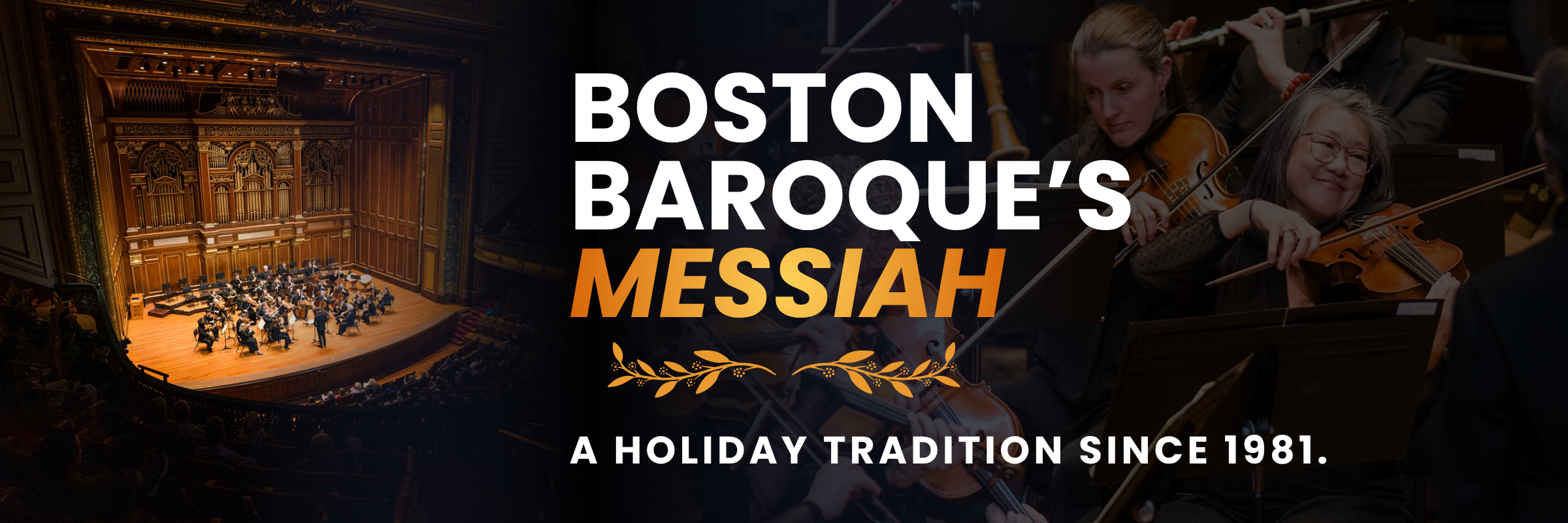
EXPERIENCE THE TRADITION LIVE
Handel's Messiah | Boston Baroque
Saturday, December 12, 2026 | 7:30 PM
Sunday, December 13, 2026 | 3:00 PM
New England Conservatory's Jordan Hall, Boston